
How to Calculate OSHA 300A Total Hours Worked and Average Employees
Picture this: It's late February, and the OSHA 300A summary form stares back from your desk, those two blank boxes demanding the annual average number of employees and total hours worked. For payroll coordinators, office managers, HR leads, and small-business owners, filling them feels like decoding a puzzle with real stakes. Get it wrong, and your posted summary misrepresents your workplace safety record.
The straightforward answer starts here. The OSHA 300A requires your establishment's annual average number of employees, calculated by adding headcounts from each pay period, dividing by the total pay periods (including those with zero employees), and rounding up to the next whole number. For total hours worked—the focus when people search how to calculate OSHA 300A total hours worked—sum only the actual hours employees spent working, excluding vacation, sick leave, holidays, or other paid non-work time. These figures come from 29 CFR 1904.32 and anchor the summary you post each year.
Why Annual Average Employees and Total Hours Worked Matter
These two numbers occupy key spots on the 300A summary form, right alongside your recordable injury and illness counts. They provide context for anyone glancing at the posted form—from employees to visitors to OSHA inspectors. Beyond posting, they form the foundation for incidence rates if your business ever calculates them formally. Accurate figures reflect your true workforce size and activity level, ensuring the summary tells an honest story about safety performance.
OSHA designed the 300A for establishments with 10 or more employees in certain industries, or all with 20-250 depending on updates. Even in a year with zero cases, you must complete and post these fields. Skipping them invites scrutiny. Link this calculation to your full OSHA 300A posting requirements for the complete picture.
Step-by-Step: Calculating Annual Average Employees
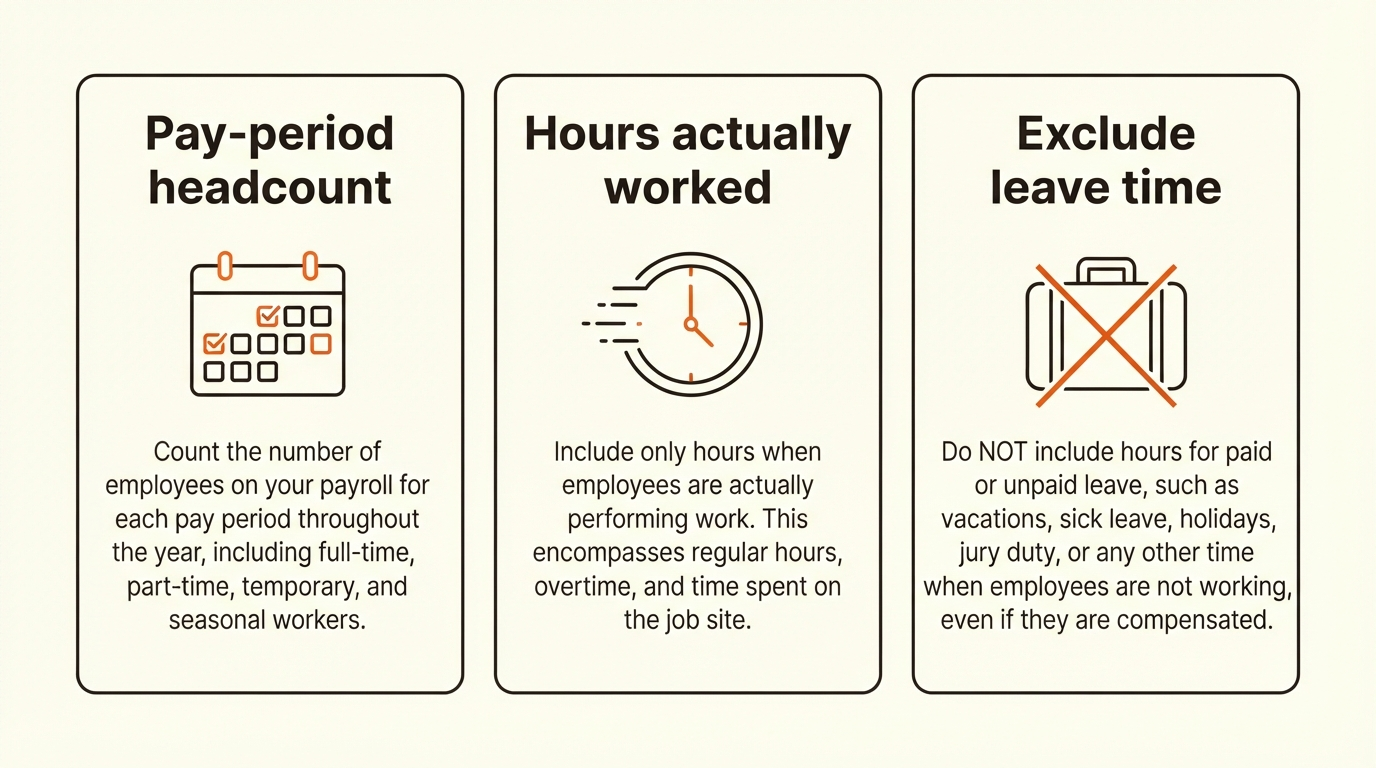
Follow OSHA's worksheet from the official forms package. First, tally the number of employees on payroll for each pay period throughout the calendar year. Include full-time, part-time, temporary, seasonal, salaried, and hourly workers. Count every pay period, even those with zero employees.
Add those headcounts. Divide the total by the number of pay periods. Round the result to the next highest whole number. That gives your annual average.
Hypothetical Example: A Seasonal Shop
Consider a hypothetical retail shop using biweekly pay periods, totaling 26 for the year. Headcounts fluctuate: 12 employees in January's periods, rising to 15 during holiday season, dipping back. The sum of all 26 pay-period headcounts is 338.
Divide 338 by 26. That yields 13 exactly—no rounding needed. If the quotient were 13.1, round up to 14. This method captures workforce flux without overcounting peaks or ignoring lulls.
- Record headcount per pay period: e.g., 12, 12, 13, ..., up to 15, 15.
- Sum: 338.
- Pay periods: 26.
- Average: 338 ÷ 26 = 13 (or round up if fractional).
How to Calculate OSHA 300A Total Hours Worked
Total hours worked means hours actually worked by all covered employees. Pull from timekeeping records if available. Sum hours from salaried, hourly, part-time, seasonal, and other workers you supervise daily, like those from a temp agency. Include overtime worked, but exclude vacation, sick leave, holidays, jury duty, or any paid time off. Non-work hours stay out, even if compensated.
If your records track only hours paid, estimate actual work hours per OSHA FAQ 32-1. Start with payroll data, then adjust downward for known non-work time.
Building from Time Records
In a hypothetical manufacturing setup, hourly workers log 1,800 hours in Q1 via punch clocks. Add part-time shifts: 200 hours. Seasonal hires contribute 1,200 over summer. Supervised temps add 800. Total for the year: sum all such actual work entries. Overtime counts fully if performed.
- Hourly: Straight from timesheets.
- Part-time/seasonal: Exact shifts worked.
- Temps supervised daily: Their work hours under your direction.
- Overtime: Included as worked time.
Estimating for Salaried Employees or Hours-Paid-Only Records
Salaried staff and non-hourly payroll often lack precise hour logs. Here, estimate based on scheduled workweeks minus documented leave. For a hypothetical office with five salaried employees, each scheduled for 40 hours weekly over 52 weeks totals 10,400 potential hours. Subtract 400 hours of tracked vacation and sick time per person: 9,000 hours per employee, or 45,000 total.
Document your method: scheduled hours, adjusted for absences. Cross-check with calendars or HR systems. This beats vague guesses, aligning with OSHA's call for reasonable estimates in FAQ 32-1.
The 2,000-Hour Shortcut: Proceed with Caution
Do not treat 2,000 hours per full-time employee as an OSHA-required formula.
Many hear of multiplying full-time equivalents by 2,000—roughly 40 hours times 50 weeks, nodding to average leave. OSHA neither mandates nor endorses it. Use actual records first. If estimating, apply it only to full-time salaried staff, then add overtime, part-time, seasonal, and temp hours separately. Document adjustments clearly.
In our hypothetical shop: 10 full-time at 2,000 hours each (20,000), plus 5,000 part-time/seasonal, plus 3,000 temps. Total: 28,000. But verify against real data—2,000 can inflate if leave runs low or deflate with heavy overtime.
Who Counts in These Calculations
Cover employees your establishment pays directly or supervises day-to-day, per 1904.32. That pulls in full-timers, part-timers, temps under your watch, and seasonal help. Exclude corporate HQ staff or independent contractors not supervised daily. For deeper dives on coverage, see OSHA's forms package or related recordkeeping guidance.
Common Mistakes to Avoid
Pitfalls trip up even diligent teams. Watch for these:
- Using hours paid instead of hours worked: Paid leave inflates totals.
- Forgetting supervised temps or seasonal spikes.
- Counting non-work time like holidays.
- Averaging from a single day's snapshot, not all pay periods.
- Leaving fields blank on zero-incident years—they remain required.
Double-check payroll exports against OSHA rules each time.
Ensuring Your Calculations Stand Up
These steps draw directly from 29 CFR 1904.32, OSHA FAQ 32-1, and the forms package worksheet. They are not legal advice. Always consult your payroll records and the latest OSHA instructions at osha.gov/recordkeeping/forms. Trends shift; verify annually.
Tools like FORM 300 LOGBOOK streamline this. It keeps your year's cases centralized, making summary assembly less daunting—without importing payroll or filing for you.