
OSHA First Aid vs. Medical Treatment Beyond First Aid: What Gets Recorded?
Imagine a warehouse worker slices a finger on a sharp edge during a routine shift. Blood flows. A supervisor grabs the first-aid kit, cleans the wound, and applies a bandage. Later that day, the employee visits a doctor who recommends stitches. Does this incident go on your OSHA 300 Log?
The answer hinges on OSHA first aid vs medical treatment beyond first aid. A work-related injury records on the OSHA 300 Log only if it meets one of the general recording criteria in 29 CFR 1904.7—such as medical treatment beyond first aid. OSHA provides a complete list of first aid procedures. If the care matches that list exactly, it is first aid, even from a physician. Anything else is medical treatment beyond first aid. But recordability also requires work-relatedness, plus criteria like death, days away from work, restricted work, loss of consciousness, or a significant diagnosed injury or illness.
OSHA Recordkeeping Fundamentals
OSHA requires employers to track work-related injuries and illnesses on Forms 300, 300A, and 301. Small businesses with 10 or fewer employees, or in low-hazard industries, may qualify for partial exemption. But if recordkeeping applies to you, accuracy matters. Fines for errors can reach thousands per violation.
The five general recording criteria under 29 CFR 1904.7 trigger entries:
- Death.
- Days away from work.
- Restricted work or job transfer.
- Medical treatment beyond first aid.
- Loss of consciousness.
- Significant injury or illness diagnosed by a physician or licensed health care professional—like cancer, chronic irreversible disease, fractured or cracked bone, or punctured eardrum. These record even without treatment or restriction, at diagnosis.
Medical treatment beyond first aid stands out as the most common trigger for minor incidents. Understanding OSHA first aid vs medical treatment beyond first aid prevents under- or over-recording.
Defining Medical Treatment Beyond First Aid
Medical treatment means the management and care of a work-related injury or illness to combat disease or disorder. It excludes:
- Visits solely for observation or counseling.
- Diagnostic procedures, like X-rays or blood tests—including prescription medications used only for diagnostics, such as eye drops to dilate pupils.
- First aid, as defined precisely in the regulation.
Who provides the care does not matter. A physician's bandage qualifies as first aid. A nurse's stitches count as medical treatment. If a physician or licensed health care professional recommends medical treatment—even if the employee declines—it records.
Diagnostic imaging alone, like an X-ray for a possible fracture, is not medical treatment. But if it reveals a fractured bone, record as a significant injury.
The Complete OSHA First Aid List
OSHA's definition in 29 CFR 1904.7(b)(5)(iii) is exhaustive. No other procedures qualify as first aid. Here is the full list:
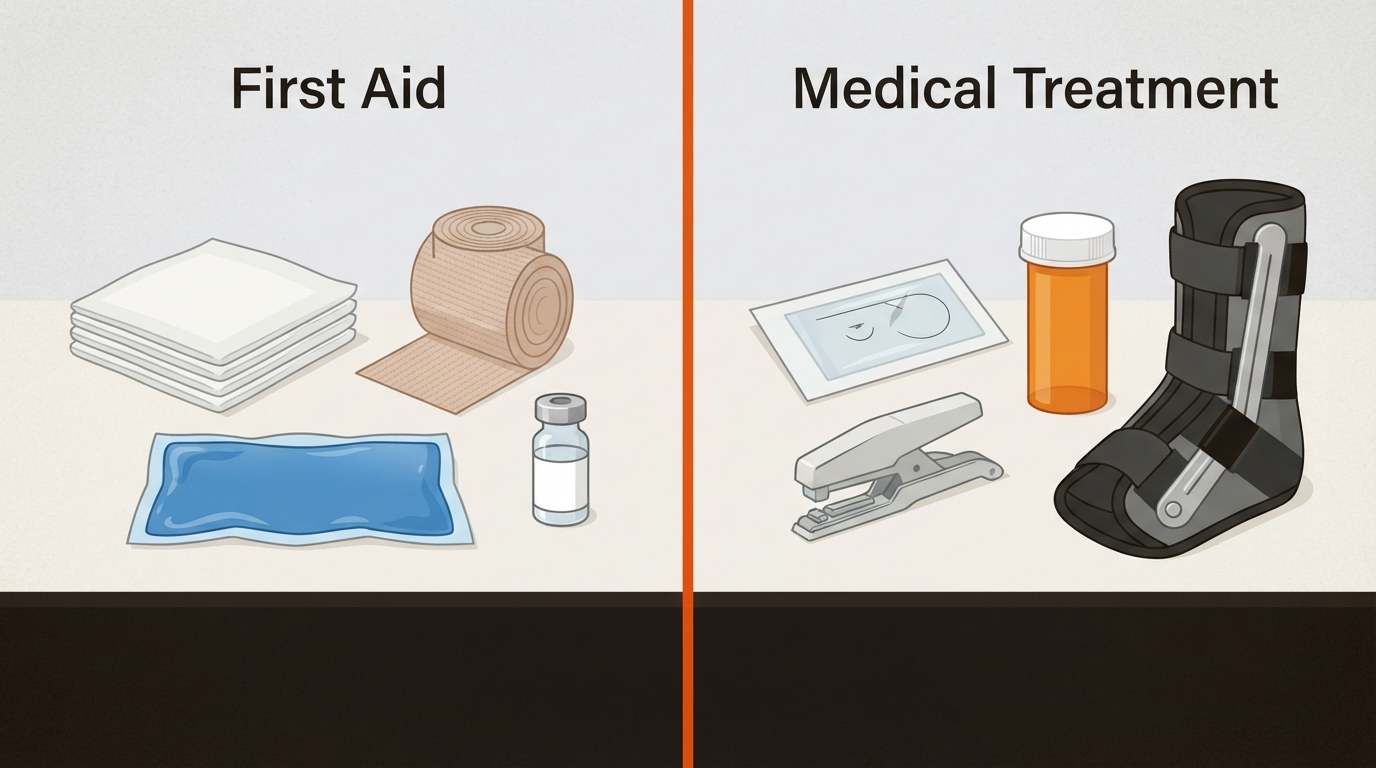
- Using non-prescription medications at non-prescription strength. (A recommendation for prescription-strength use is medical treatment.)
- Administering tetanus immunizations. (Other shots, like Hepatitis B or rabies, are medical treatment.)
- Cleaning, flushing, or soaking wounds on the skin's surface.
- Using wound coverings such as bandages, gauze pads, butterfly bandages, or Steri-Strips. (Sutures, staples, or other closing devices are medical treatment.)
- Hot or cold therapy.
- Any non-rigid means of support, like elastic bandages, wraps, or non-rigid back belts. (Rigid stays or immobilization devices are medical treatment.)
- Temporary immobilization devices used while transporting a victim, such as splints, slings, neck collars, or backboards.
- Drilling a fingernail or toenail to relieve pressure, or draining fluid from a blister.
- Eye patches.
- Removing foreign bodies from the eye using only irrigation or a cotton swab.
- Removing splinters or foreign material from areas other than the eye by irrigation, tweezers, cotton swabs, or other simple means.
- Using finger guards.
- Massages. (Physical therapy or chiropractic treatment is medical treatment.)
- Drinking fluids for heat stress relief.
Stick to this list. Deviate, and it becomes medical treatment beyond first aid.
Practical Examples: First Aid or Recordable?
Clear First Aid Cases
- A worker burns an arm on hot machinery. Supervisor applies cold pack and bandage. First aid—no recording unless other criteria apply.
- Employee gets a splinter. Tweezers remove it. First aid.
- After a cut, a doctor gives tetanus shot and cleans wound. First aid.
Medical Treatment Beyond First Aid
- That warehouse finger slice needs sutures. Medical treatment—record.
- Twisted ankle gets prescription ibuprofen at higher dose. Medical treatment.
- Back strain treated with rigid brace. Medical treatment.
- Eye injury requires prescription antibiotic drops—not diagnostic. Medical treatment.
Recall the cut finger: Bandage alone? First aid. Stitches? Recordable, assuming work-related.
Step-by-Step Decision Guide
Follow these steps for every work-related injury or illness:
- Confirm work-relatedness (29 CFR 1904.5).
- Check for death, days away, restriction, or loss of consciousness. If yes, record.
- Assess for significant diagnosis like fracture. If yes, record.
- Evaluate treatment against the first aid list. Match exactly? First aid. Otherwise, medical treatment beyond first aid—record.
- Note physician recommendations, even if ignored.
- Document details on OSHA Form 301 for the incident report.
Download an OSHA 300 Log template to start organized. For full guidance, see our step-by-step instructions.
Key Caveats for Accurate Recordkeeping
OSHA first aid vs medical treatment beyond first aid is just one path. A case limited to first aid records if it causes days away from work or restricted duty. Small businesses should review OSHA recordkeeping requirements.
Employers in OSHA State Plan states must confirm state-specific rules, which may differ.
This guide educates on federal 29 CFR 1904.7. It is not case-specific legal or medical advice. FORM 300 LOGBOOK is independent software, not affiliated with OSHA or the U.S. Department of Labor. Consult professionals for your situation. Learn more about the OSHA 301 Incident Report Form.
Streamline Your Process with FORM 300 LOGBOOK
Tracking treatment details prevents year-end confusion. Use the FORM 300 LOGBOOK workspace at form300logbook.com/app to log cases, attach notes, and generate Forms 300, 300A, and 301. Guided entry captures facts like treatment type upfront, keeping everything organized.
One slip-up in classifying first aid can skew your rates and invite scrutiny. Get it right from the start. Your records reflect not just compliance, but care for your team.